Plaintiffs alleging bodily injury as a result of exposure to talc fibers has emerged over the last ten years, or so, as a major mass tort in the United States. The headlines connecting exposure to cosmetic talc, especially body powder focusing on Johnson & Johnson, have primarily asserted ovarian and other reproductive cancers in women. More recently, but with equal vehemence, plaintiffs have alleged asbestos exposure due to asbestos contamination in talc. Traditional asbestos-related diseases such as mesothelioma, and to a lesser extent, lung cancer, are now the subject of numerous lawsuits asserting bodily injury. According to KCIC’s complaint tracking data, there has been a 300% increase in the intensity with which talc defendants are named alongside traditional asbestos defendants on mesothelioma bodily injury lawsuits between 2021 and 2025. In case more frisson was needed, the International Agency for Research on Cancer, under the auspices of the World Health Organization, published in June 2025 Volume 136 of its ongoing series of monographs on evaluating the carcinogenic hazard of chemicals to humans. Volume 136, Talc and Acrylonitrile, does not beat around the bush. It finds that talc, uncontaminated by asbestos, is probably carcinogenic to humans. It further concludes that a positive association between talc and ovarian cancer is credible.1
Notwithstanding the IARC monograph, it is still fair to say that the scientific evidence of causation and whether or not talc was asbestos contaminated, remains hotly disputed. The IARC monograph itself has been sharply criticized by defense attorneys. There will be much water to flow under the bridge before a consensus emerges, if ever. However, given exponentially increasing volume of talc-related complaints, both asbestos-related and non-asbestos-related, these issues will be before the eyes of those of us that labor in the mass tort arena.
This is the first in a series of talc-related articles and blog posts from the KCIC team, and in it we seek to set the table with a brief summary of the use of talc in industrial and cosmetic industries in the U.S.
Talc has occupied a significant place in industrial development due to its practical utility, wide availability, and adaptability across manufacturing sectors. It is a naturally occurring hydrated magnesium silicate, distinguished by its status as the softest known mineral. Composed of layered sheets weakly bonded to one another, talc’s structure offers high flexibility, a slippery feel, and low thermal conductivity. Over time, its economic relevance has been driven less by its mineralogical features alone and more by the range of industrial problems it has been able to solve: improving product performance, facilitating processing, and reducing manufacturing costs.
Historically, talc’s softness and workability made it useful in carved objects and early ceramic applications. With industrialization, however, its role expanded dramatically. The growth of mechanized manufacturing in the nineteenth and twentieth centuries created demand for functional fillers, extenders, and processing aids. Talc’s capacity to serve in these roles, combined with its relative abundance, allowed it to become embedded in large-scale industrial supply chains. Major deposits are found in multiple countries, including China, India, the United States, Brazil, and Finland, and global production has reached millions of metric tons annually in recent decades.2 Its widespread availability and comparatively low cost have reinforced its position as a preferred material in numerous sectors, ensuring stable international trade and long-term industrial reliance.
As industrial economies expanded, so too did the extraction and refinement of talc, establishing mining and milling operations capable of producing consistent grades tailored to commercial needs. Among its most significant commercial applications is its use in plastics manufacturing. As thermoplastics, particularly polypropylene, became central to automotive, consumer goods, and packaging industries, talc emerged as a widely used reinforcing filler.3 Its incorporation improved stiffness, heat resistance, and dimensional stability, making it attractive in cost-sensitive, high-volume production environments.
The ceramics, paints, and paper industries have also been longstanding consumers of talc. As production of tiles, sanitary ware, and electrical ceramics grew, talc served as a functional ingredient that contributed to product durability and manufacturing efficiency. These enhanced performance characteristics similarly made it a practical component in protective and decorative paints and coatings. In paper manufacturing, talc became important as both a filler and a process aid; it contributed to improvements in paper smoothness, opacity, and print quality, while also assisting in process control during pulp treatment. The expansion of global publishing, packaging, and communication industries further amplified talc’s prevalence in industrial supply chains.
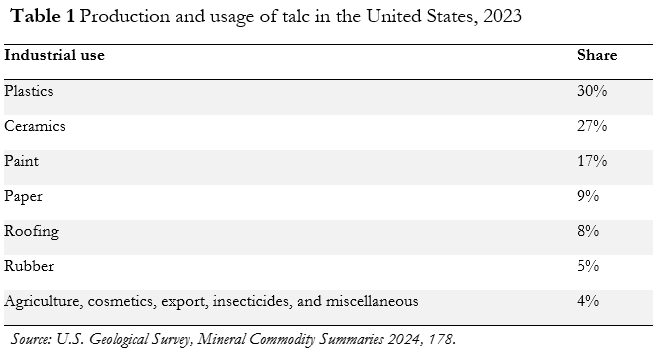
Perhaps the most publicly visible application of talc has been in cosmetics and personal care products. Talc’s absorbent and lubricating properties gave rise to widespread manufacturing of talc-based body powders and facial products that reduced friction and allowed for smoother application. The commercial success of these products significantly increased talc’s household presence. Despite its broad societal familiarity, however, less than 4% of talc’s total usage in US products derived from the cosmetics industry in 2023, as seen in Table 1. Talc also found use in pharmaceutical and food processing contexts as an excipient or anti-caking agent, reflecting regulatory acceptance of its functionality within controlled manufacturing standards.
The industrial history of talc has been shaped by variability in mineral deposits and concerns regarding contamination with asbestos-form minerals in certain geological settings.4 These issues have influenced regulatory oversight, quality control practices, and scientific evaluation over time. As a result, talc’s commercial trajectory has not been defined solely by its economic utility, but also by evolving standards governing extraction, processing, and end-use applications.
From early utilitarian uses to its incorporation into plastics, ceramics, paper, coatings, cosmetics, and pharmaceuticals, talc’s prevalence has been driven by sustained industrial demand and global production capacity. Its continued presence in diverse commercial sectors underscores its role as one of the foundational industrial minerals of the modern era. Understanding its history and prevalence provides critical context as we contend with the evolving landscape of talc-based liability claims.
We will continue this series first with an examination of the emerging filing patterns of talc companies being named alongside traditional asbestos defendants. Having monitored talc verdicts, both ovarian cancer and mesothelioma, for the past 10+ years, we will go on to review these data points too. Stay tuned!

Jonathan Terrell is the Founder and President of KCIC. He has more than 40 years of international financial services experience with a multi-disciplinary background in accounting, finance and insurance. Prior to founding KCIC in 2002, he worked at Zurich Insurance, JP Morgan, and PriceWaterhouseCoopers.
Learn More About Jonathan