Mass tort litigation has become defined by volume. The number of Multi-District Litigations (MDLs) has grown steadily since the 1990s, and today MDLs account for more than half of the federal civil docket. Many now involve tens of thousands of individual claims. Each filing comes with its own allegations, facts and procedural history, creating a mountain of data that must be managed before it can be understood. For in-house and outside counsel alike, the challenge is not simply litigating cases, it is managing scale.
At KCIC, we recently reviewed the five largest MDL dockets by pending actions through data provided by the Judicial Panel on Multidistrict Litigation (JPML). What became clear is just how much valuable information lies buried in the docket data itself — details such as jurisdiction, filing date, plaintiff firms, and defendants. On its own, the data is flat and unmanageable. But when processed and visualized, they can reveal powerful insights.
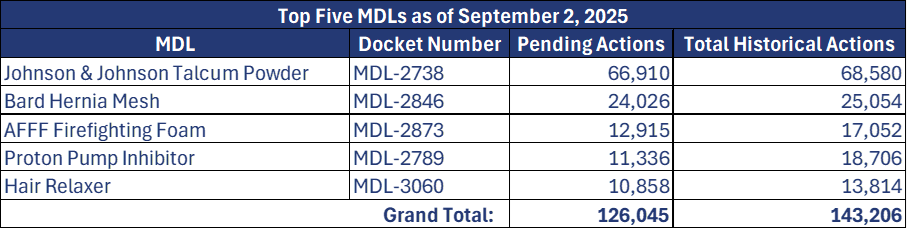
Dashboards for all five are available, and below we highlight two examples.
From Raw Data to Dashboards
The underlying data for these dashboards includes civil action numbers, case captions and associated metadata. On its own, it is not analysis-ready. To make it meaningful, we process and standardize it. For example, civil action numbers can be translated to determine which district court the filings originated in. That, in turn, allows us to track cases to states. Other fields, like plaintiff firms and defendants, can be aggregated to show which players dominate a particular MDL.
The result is a dashboard, either static or dynamically updating, that sits on top of a structured database (or data set like Excel). A dashboard can display any field being tracked and refresh automatically as new filings occur. Rather than scrolling through thousands of entries, counsel can filter by state, view filings over time, or see which firms are most active.
Johnson & Johnson Talcum Powder Litigation Dashboard
One of our sample dashboards focuses on the talc MDL, which is one of the most prominent proceedings on the federal docket.
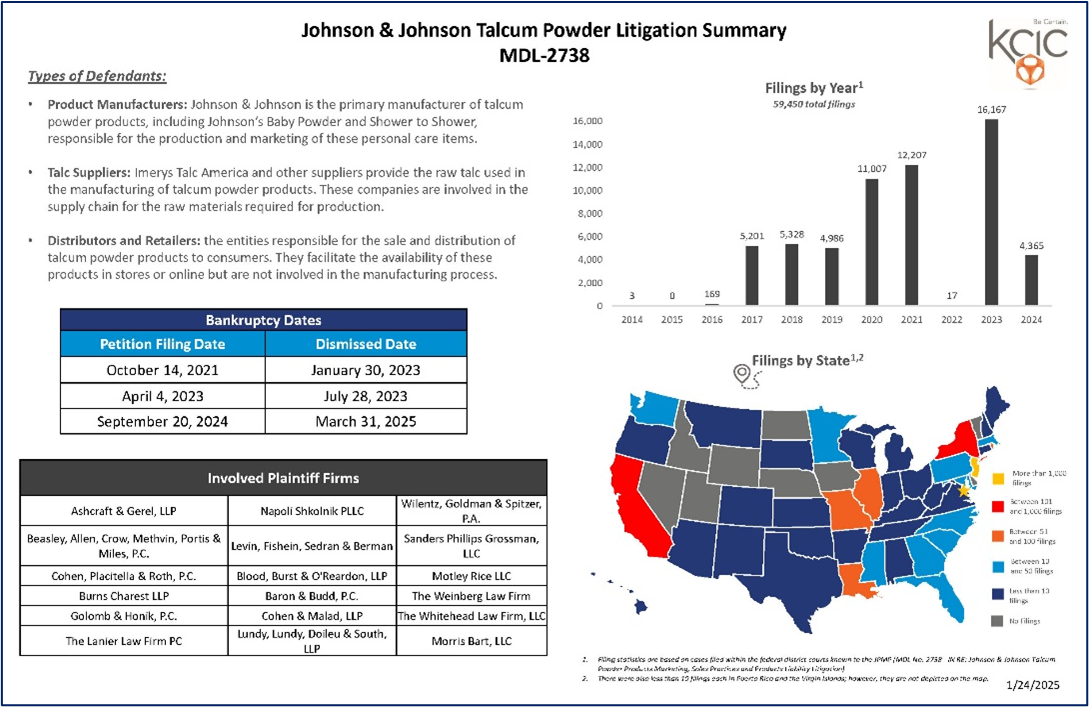
This combination of visuals turns raw docket entries into a story: the spread of filings nationwide, the influence of bankruptcy strategy, and the firms and defendants most central to the litigation.
Hair Relaxer Litigation Dashboard
Another dashboard highlights one of the newest large MDLs: hair relaxer products.
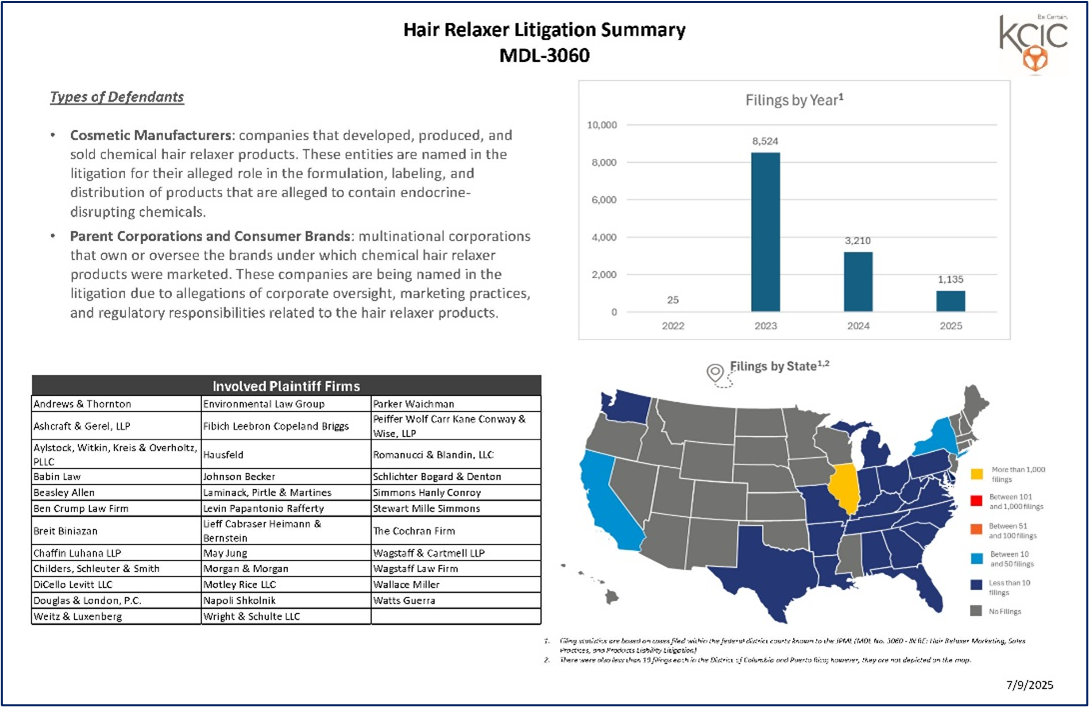
The concentration of filings in Illinois highlights how quickly an MDL can attract new cases once established. The plaintiff firm data offers an early view of which firms are shaping the litigation’s direction.
Why Dashboards Matter
Dashboards are more than visuals; they are tools for managing litigation at scale. They update automatically as new data comes in. They can be configured to track any field, from case captions to key deadlines. And they make it possible to see trends, risks, and concentrations at a glance, rather than through piecemeal reports.
For counsel, the benefits are practical: faster reporting to clients, stronger case evaluations, and better-informed strategy around motion practice, bellwether selection, and settlement negotiations.
Conclusion
The largest MDLs demonstrate just how much volume and complexity now define mass tort litigation. With dockets numbering in the tens of thousands, it is no longer feasible to rely on traditional litigation management strategies. Dashboards are a useful addition to the toolkit to transform raw data into clear, accessible summaries, enabling counsel to spot trends, monitor progress, and communicate risks more effectively.
At KCIC, we have supported defendants and their counsel through every stage of MDL proceedings. Our work has included claims analysis, forecasting/risk evaluation, insurance coverage considerations, motion practice, bellwether selection, and settlement strategy. By turning large volumes of litigation data into structured insights and visualizations, we help defense teams move beyond complexity to make informed decisions in even the most challenging mass tort environments.
Natalia Miranda, Bebe Limanowski, and Ibrahim Kabia also contributed to this post.

Kathrin Hashemi is a litigation management expert who partners with Fortune 500 and mid-market companies to navigate the complexities of mass tort litigation. With a decade of experience, she has focused her practice on helping clients obtain actionable insights from their litigation data. By leveraging advanced technology and deep case expertise, Kathrin enables her clients to manage case filings and resolutions efficiently, optimize insurance recoverability, and streamline litigation processes. She prioritizes listening to her clients, understanding the legal and contextual nuances of their cases, and providing data-driven strategies tailored to their unique needs.
Learn More About Kathrin